Comprehensive Whole-Home & Building Rewiring in South Bend
The structural integrity and fire safety of any building in South Bend fundamentally depends on the condition of the branch wiring concealed within its walls, ceilings, and crawlspaces. Throughout St. Joseph County, historic residential neighborhoods and mid-century commercial districts contain structures built between the 1900s and 1970s. Over decades of occupancy, original electrical conductors experience mechanical damage, insulation embrittlement, and unauthorized modifications by previous owners that leave properties vulnerable to electrical faults.
WATT911 connects property owners with independent electrical contractors who specialize in partial and whole-structure rewiring. These licensed trade specialists possess the technical skill to replace hazardous, obsolete wiring with modern, non-metallic sheathed cable (NM-B copper) while minimizing disruption to architectural finishes, historic plaster, and finished drywall.
Aging Wiring Systems & Associated Safety Risks
Independent electricians in South Bend frequently encounter legacy wiring technologies that no longer meet modern electrical safety standards:
- Knob-and-Tube (K&T) Wiring: Common in homes constructed prior to 1950, knob-and-tube utilizes single insulated conductors routed through ceramic porcelain knobs and tubes. K&T lacks an equipment grounding conductor, meaning modern three-prong grounded appliances cannot be safely protected. Furthermore, when modern thermal insulation (such as blown-in fiberglass or cellulose) is placed over knob-and-tube wiring, the conductors cannot dissipate heat into free air, posing severe combustion hazards.
- Solid Aluminum Branch Circuit Wiring: Homes built between 1965 and 1973 in St. Joseph County frequently feature solid aluminum branch wiring. Aluminum expands and contracts at a significantly higher rate than copper under electrical load, leading to terminal screw loosening at outlets and switches, metal oxidation, and localized electrical fires. Contractors evaluate whether complete copper rewiring or specialized Al/Cu copalum/AlumiConn crimp remediation is the safest solution.
- Cloth-Jacketed NM Cable Lacking Ground: Early generation Romex wiring installed in the 1950s utilized rubberized cloth sheathing that degrades and crumbles when exposed to attic heat, leaving bare energized conductors vulnerable to contact.
The Rewiring Process: Minimizing Disruption to Your Property
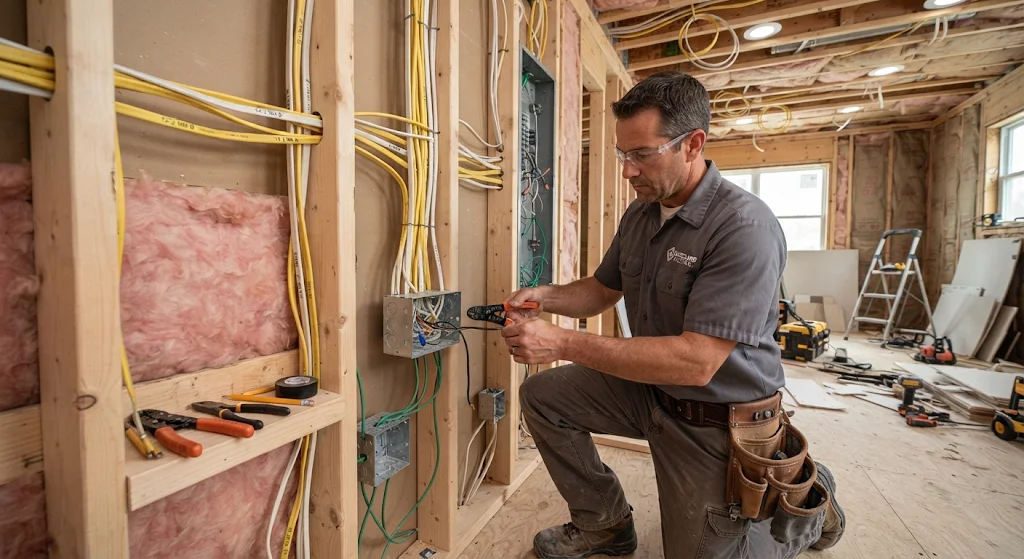
Executing a whole-home rewire requires meticulous planning and surgical installation techniques. Experienced independent electrical contractors utilize specialized flexible drill bits, fish tapes, and inspection borescopes to route modern copper NM-B cable through wall cavities from attic and basement access points. This approach minimizes cutting into original walls and preserves historic molding.
Upon completion of rough-in wiring, all circuits are terminated into new device boxes with tamper-resistant receptacles, modern switches, and dedicated neutral conductors (as required by current code for smart lighting automation). The contractor coordinates municipal inspections with the St. Joseph County building department to ensure full sign-off and documented code compliance.
Local Permitting & Code Compliance in South Bend (St. Joseph County)
In the State of Indiana, electrical trade licensing and construction permitting are administered by local municipal building commissions under Indiana Code Title 22. When contracting for Rewiring in South Bend, independent contractors must register with the local building authority in St. Joseph County, calculate continuous circuit loading under the Indiana Electrical Code (NFPA 70), and obtain formal building permits prior to commencing substantial electrical alterations.
Furthermore, projects requiring utility meter disconnections or transformer de-energization are coordinated directly between the independent contractor and the regional utility serving South Bend (such as AES Indiana, Duke Energy, Indiana Michigan Power, or CenterPoint Energy). Following completion of the work, a local municipal inspector performs an on-site code evaluation to verify grounding electrodes, overcurrent protection, and arc-fault/ground-fault compliance before utility re-energization.
Request Rewiring in South Bend, IN
Connect with an independent licensed contractor for on-site diagnostics, code-compliant load assessments, and reliable project execution in St. Joseph County.
How to Connect With a Qualified Contractor in South Bend
Taking the next step on your electrical project through WATT911 is straightforward:
- Call our Indiana coordination line at (888) 605-9975 to explain your Rewiring requirements.
- Our referral desk matches you with an independent contractor serving South Bend who maintains active local registrations and confirmed availability.
- The contractor reviews your project, performs on-site technical diagnostics or load calculations, and issues a written proposal.
- Upon your approval, the contractor pulls required municipal permits, completes the installation in accordance with code, and arranges final inspection.